
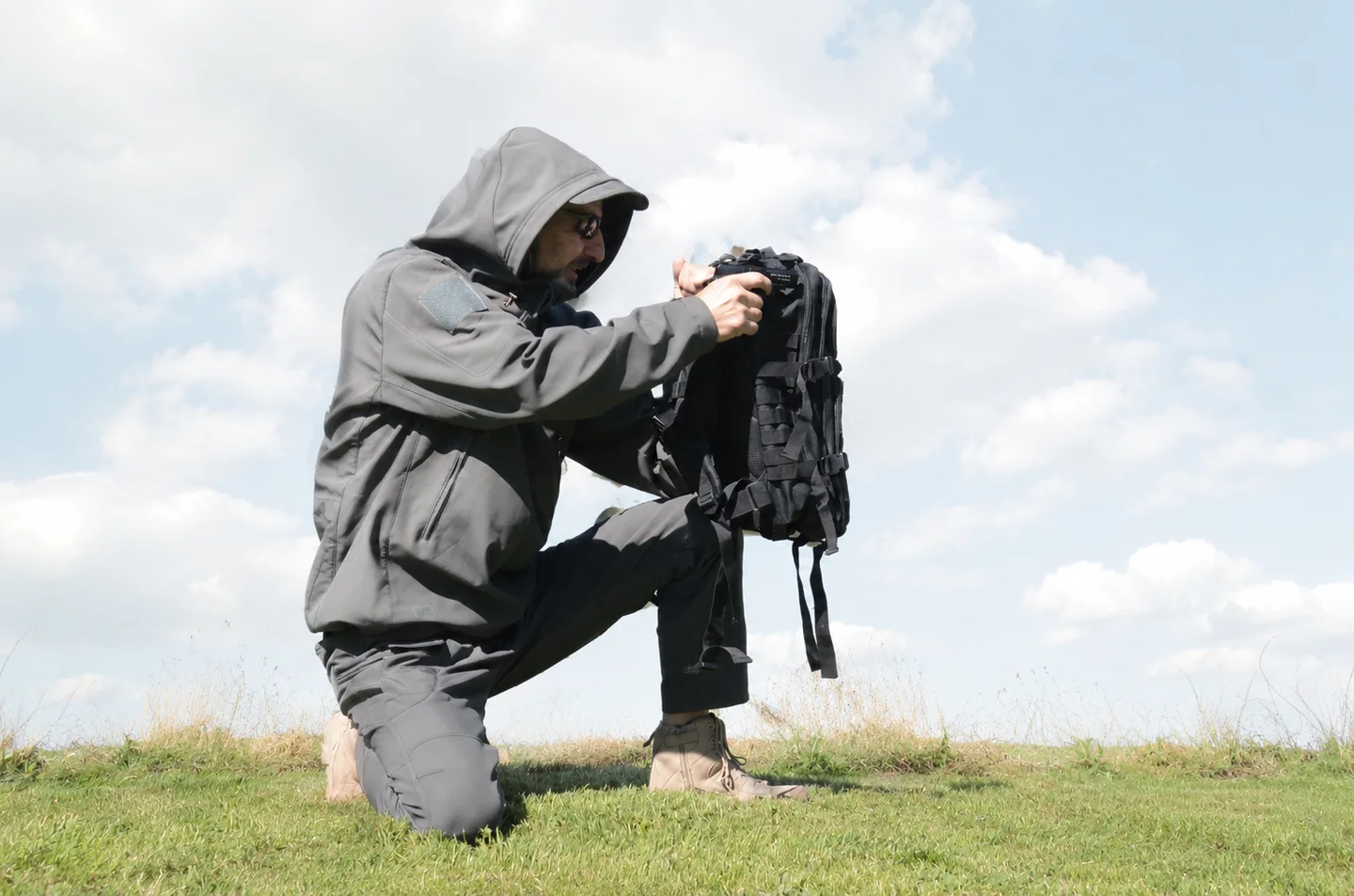
Introduction and Doctrine: Passive Cover vs. Active Deflection
Limitations of Passive Cover and Ballistic Vests
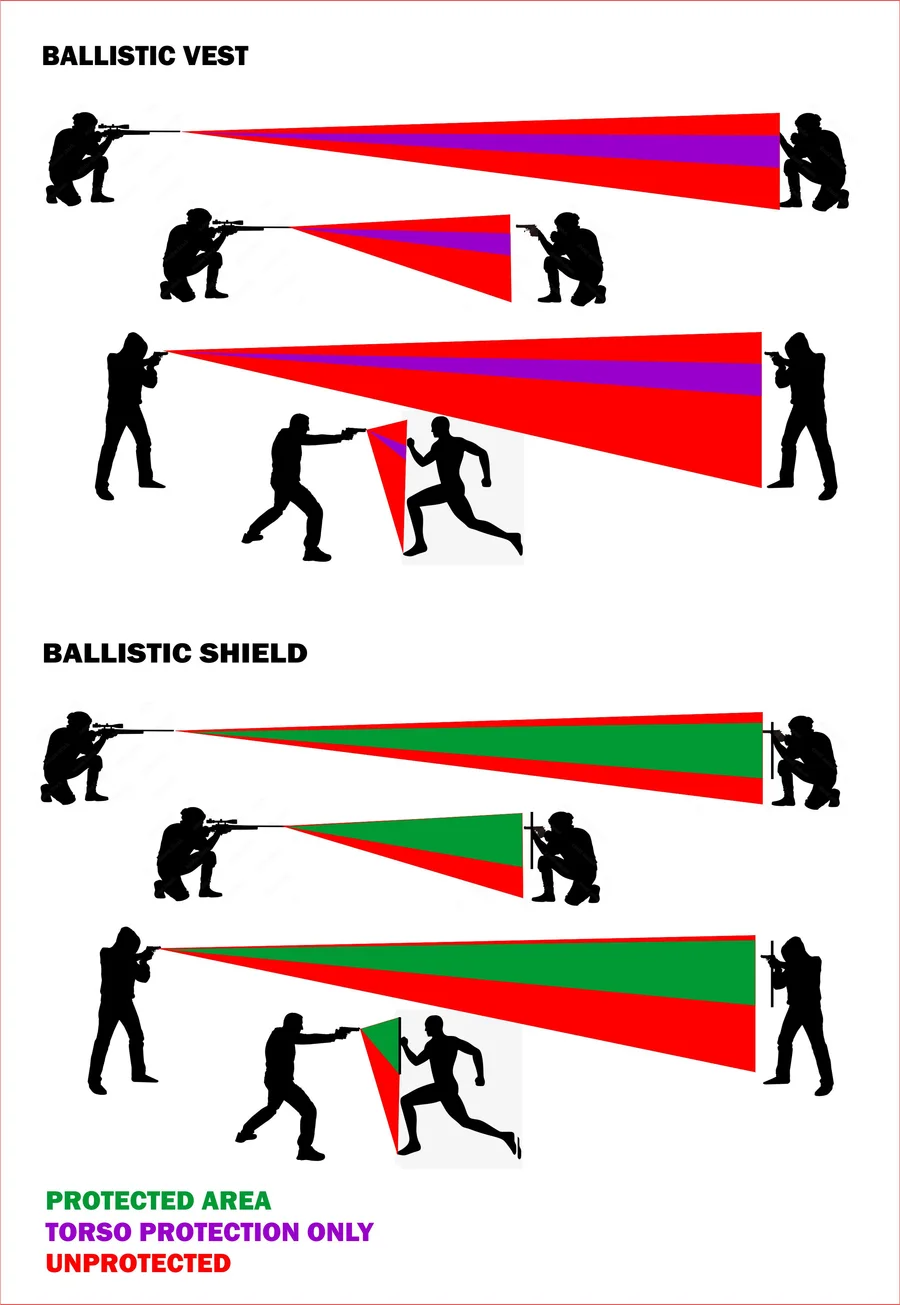
Ballistic Vests: A standard ballistic vest primarily protects the vital zone of the torso, while the operator's head and limbs remain completely exposed. Upon intercepting a projectile, kinetic energy is transferred directly to the body, carrying a high risk of severe behind armor blunt trauma and subsequent temporary incapacitation. Although a vest provides continuous area coverage, it permanently burdens the operator physically, limits mobility, and above all, does not allow for the active concentration of the protective profile toward the primary axis of fire. Thus, it represents a proven, but not universal or versatile, element of protection.
Passive Shields: Most conventional law enforcement methodologies still rely on large-area passive shields that provide static cover for nearly the entire body and serve to create so-called mobile walls. These systems often feature limited viewports and an inadequate ratio between extreme weight and low ballistic resistance. This represents a conservative, obsolete historical concept suitable mainly for specific (e.g., riot control) situations, which no longer corresponds to the dynamics of modern asymmetric threats.
The Doctrine of Active Cover
In contrast to the static approach, active cover represents a dynamic concept, the operational advantage of which is most pronounced during a sudden encounter at medium and longer distances. This creates a fundamental tactical asymmetry:
During instinctive shooting, the protected operator intuitively directs fire at the center of mass of the opponent's body.
The unprotected shooter, on the other hand, subconsciously seeks random cover, experiences a time delay, and is forced to complexly target the reduced exposed areas on the operator's body.
The operator can additionally actively work with the shield's profile—for example, transitioning into a partial kneel maximizes coverage to approximately 75% of the body surface while establishing highly stable support for precise fire. In extreme situations, such as a prone position, the shield can provide up to 95% ballistic coverage.
Biomechanical Prerequisites and the Theory of Active Deflection
Target Transition and Cognitive Reset (OODA Loop): If the attacker discovers during the preparatory phase that their primary target (center of mass) is suddenly protected by a forward-positioned shield, they are surprised, resulting in a reset of their OODA loop. Their brain must visually evaluate the unexpected obstacle, halt the original motor plan, locate a new reduced area (e.g., a limb), and issue a new motor command. This process alone takes 300 to 500 ms.
Fitts's Law: This biomechanical principle states that the time required to transition to a target depends on its size. While the operator fires intuitively at a massive area (the opponent's center of mass), the attacker must complexly aim at a very small, reduced, and moving exposed area (e.g., a leg). Precise aiming at a small target takes an additional 400 to 800 ms.
Aiming and Trigger Pull: The final focal alignment on the target and the mechanical travel of the trigger take merely tens of milliseconds (approx. 20–50 ms).
Bullet Flight to Target: At the moment of shot initiation, it is too late for any reaction. High-velocity rifle ammunition reaches impact velocities around 850 to 1000 m/s. In a standard encounter at a distance of 10 meters, the bullet's flight to the target takes approximately 10 to 12 milliseconds. Any attempt to react by dodging the body to the sound of the gunshot is absolutely impossible given the limits of human physiology.
Total Attacker Delay: This complex process delays the attacker by an average of 730 to 1360 milliseconds, frequently resulting in prolonged tactical hesitation (freezing). Therefore, it is impossible to rely on values around 400 ms, which correspond to a pre-rehearsed weapon transition to a large and anticipated target (typical for IPSC sport shooting, where the shooter knows in advance where to shoot). The attacker thus completely loses fluidity and initiative.
Operator's Tactical Timeline (Decision and Shield Movement)
Time to Shoot: Upon the initial encounter, the trained operator gains a large time window during which they intuitively fire at the target formed by the fully exposed center of the opponent's body.
Time to Decide for Action: If a trained operator opts for a restrained approach, such as negotiating with an inactive weapon holder, they lose the initial major advantage of immediate fire, yet still maintain a tactical and temporal advantage over the potential attacker. The moment their vision detects an anomaly in the opponent's movement and an attempt to aim, the operator can initiate an effective and dynamic insertion of the shield into the trajectory of fire in about 200–300 ms from the onset of the detected movement, during which time they can already deliver defensive fire at the aimed and fully exposed center of the opponent's body.
Close Quarters Battle (CQB) Crisis Deflection
Close contact (with an attacker armed with an edged weapon or firearm) offers a wide spectrum of tactical modifications—from protected negotiation to a hard active intervention. Professional simulation studies (e.g., Force Science Institute) have long proven that the safe distance against a knife-wielding attacker ranges from 9 to 11 meters. The application of a ballistic shield radically eliminates this risk. The shield absorbs impacts, deflects slashing and stabbing attacks, and provides the operator with the necessary reaction time to effectively neutralize the threat.
Approach Tactic and Shield Strike: If the attacker passively holds a weapon, the shield provides the operator with a safe space for negotiation, with or without a drawn weapon. In the event of escalation, the operator can actively block the attack and fire, or utilize a rapid lunge toward the target. This maneuver sharply increases the shield's protective shadow, and the attacker completely loses visual control over the operator. The kinetic energy delivered into the strike by the edge or flat surface of the shield destabilizes the opponent and reliably knocks the weapon from their hand.
In conducted practical tests simulating the drawing of a firearm against a knife, a forward-positioned shield functions similarly: the drawing of a weapon by the opponent is ineffective, as their field of fire is completely covered at the moment of approach, and the kinetic impact of the shield eliminates the weapon before an aimed shot is fired, or the shot merely impacts the shield.
Structural Requirements for a Dynamic Shield
The active tactical methodology demands highly specific parameters that conventional shields do not meet.
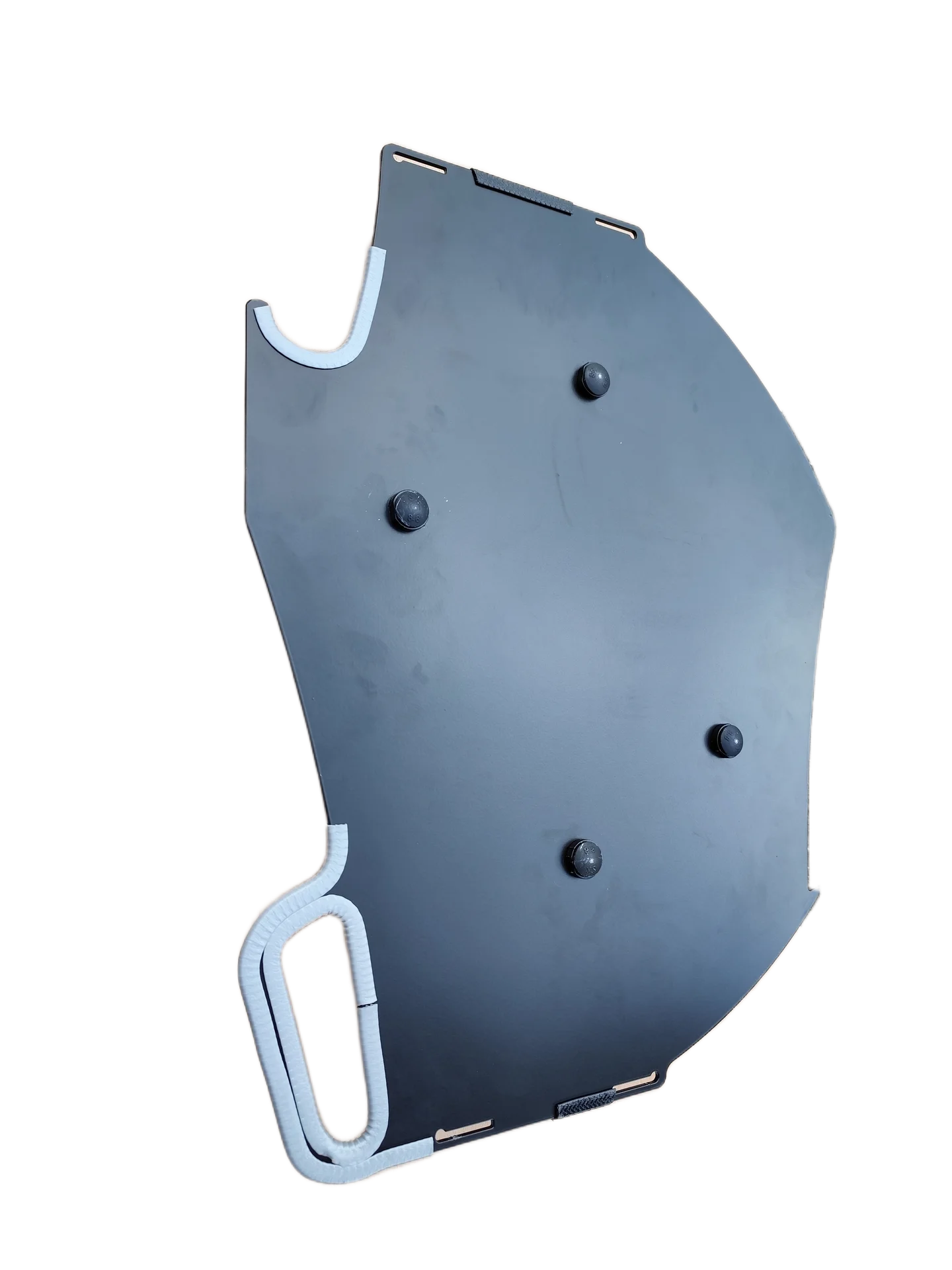
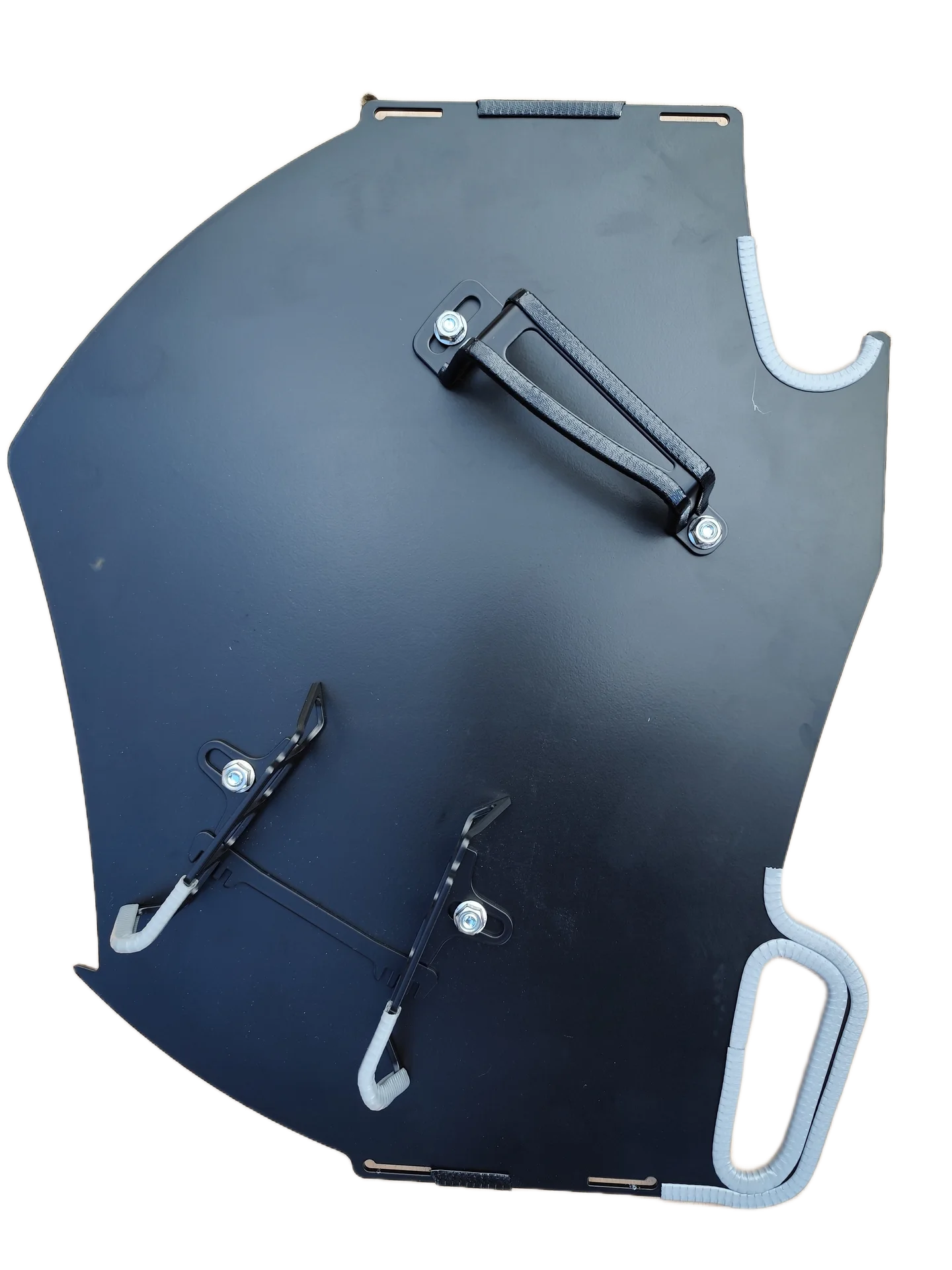
Weight Optimization: The maximum weight for effective reactive operation (one-handed manipulation) ranges between 5–8 kg. Higher weight increases the shield's inertia and critically slows the operator's reaction time. Conversely, an adequate mass of homogeneous steel reliably absorbs the kinetic energy of incoming projectiles and allows the operator to maintain balance even under multiple hits, without causing injury to the hand due to vibration or material deflection.
Grip Geometry and Ergonomics: The shield requires an ergonomic handle and forearm fixation that respect body physiognomy. This enables a firm grip and the directional orientation of the shield in space without a loss of stability.
Ballistic Stability (Multi-hit): Only a specially high-alloyed steel structure can absorb repeated hits without degradation and retain full ballistic resistance. A frequent problem with modern composite or sandwich systems is their irreversible destruction, weakening of edges, and loss of resistance immediately after the first sustained hit.
Minimization of Secondary Fragmentation Risks: With correct use (appropriate forward positioning of the shield), it is not strictly necessary to burden the shield with anti-fragmentation coatings. The risk of secondary fragmentation from lead or jacketed shrapnel is negligible compared to the advantage of immediate safety and the preservation of vital zones.
Comprehensive Spectrum of Shield Protection
A properly dimensioned ballistic shield provides a modular barrier protecting the operator against a wide range of threats:
- Against firearms (depending on ballistic certification—from handguns to long rifles).
- Against edged weapons (deflection of slashing, stabbing, and blunt strikes).
- Against explosions, ricochets, and fragmentation (the ability to absorb blast waves and catch flying shrapnel).
- Against future asymmetric threats (specifically, protection against small attack drones).
Areas of Deployment and Target User Groups
Ballistic shields represent a highly versatile protective asset whose variability and mobility enable a wide spectrum of operational deployment across various sectors. Given the diversity of threats and specific environments, utilization can be divided into the following main categories:
Armed and Security Forces
Police Patrols and First Responders: Immediate protection during initial contact with an active shooter or armed attacker. The shield provides essential cover in instances where hard cover is unavailable, ensuring safe approach and threat neutralization.
Intervention and Special Units (SWAT): Dynamic entries (CQB - Close Quarters Battle) into structures, high-risk arrests, and the resolution of complex crisis situations. Heavier ballistic shields providing maximum ballistic protection are utilized here.
Military Operations: Urban warfare, perimeter control, and protective barricades. Highly durable military versions of shields designed for the highest levels of ballistic protection are deployed.
Close Protection and Security Services
Close Protection / VIP Protection: Rapid deployment of concealed ballistic shields (e.g., in the form of ballistic backpacks) to evacuate a protected person and create a barrier against ambush attacks.
Critical Infrastructure and Facility Security: Equipping gatehouses, reception desks, and checkpoints in banks, government offices, or other exposed locations. This allows security personnel (even unarmed) immediate cover from gunfire or edged weapon attacks.
Emergency Services and Civil Defense
EMS and Fire Rescue Services (HZS): Entry into hazardous areas to provide first aid and evacuate injured individuals during ongoing armed incidents (Tactical Emergency Casualty Care - TECC).
Public and Institutional Environments
Schools and Educational Facilities: Crisis equipment for educators and school security enabling effective classroom lockdown and the protection of students from an attacker.
Government Offices and Public Institutions: Protection of personnel from attacks and securing safe evacuation during security breaches.
Transportation and Specific Applications
Mobile Protection in Vehicles: Utilizing shields to create immediate supplementary protection inside vehicles, serving as an improvised barrier during evacuation, and for cover during the transport of threatened individuals.
Air and Rail Transport: Improvised protection during hijackings or other threats aboard commercial transport vehicles.
Protection During Terrorist and Crisis Situations
Shields serve as an effective protective asset in unstable environments, providing defense against a broad spectrum of threats—from gunfire and fragmentation (e.g., from Improvised Explosive Devices – IEDs) to attacks by small combat drones (e.g., FPVs).
Operator Training and Education
The physical properties of a ballistic shield alone represent only a passive protective potential. The true tactical advantage is achieved only by combining this equipment with adequate training and muscle memory. Implementing a shield into an arsenal requires specific methodological preparation, which is equal in importance to standard firearms training or tactical procedures drills.
Universality of Training (Armed and Unarmed Personnel): Active cover training is not exclusively the domain of elite police and military units. Mastering the basic methodology allows even unarmed personnel (building security, guards, receptionists, or educators) to gain a massive defensive advantage. A trained civilian operator can secure immediate cover during an unexpected incident, retreat to a safe area of a building, secure entryways, or activate an alarm system, thereby potentially saving their own life and the lives of those around them.
Active Pacification and Defense: A trained operator can fully utilize the shield's weight and profile for active defense. During an edged weapon attack, a correct grip and stance provide a highly effective barrier (a knife slides off the shield), affording the operator a safe space for a potential rapid lunge and the pacification of the attacker. Against a firearm-wielding attacker, training (working with angles and deflecting the line of fire) offers a realistic hope for survival, safe retreat, or effectively disarming and pacifying the attacker with the shield.
Multidisciplinary Use (Explosions and Fires): A trained operator can utilize the shield even in situations exceeding standard ballistic threats. The steel structure acts as an effective shield catching or deflecting flying fragments and can partially absorb the blast wave during an explosion (e.g., hand grenades or improvised explosive devices). Furthermore, it can be utilized as improvised thermal cover protecting the body surface during the evacuation of personnel from fire-affected areas.
Choose equipment for your environment.
Tell us about the intended use, required protection and carrying requirements. We will help you explore the available configurations.